Albania

OFFICIAL NAME: Republic of Albania
AREA: 28,748 km2
POPULATION: 2,876,591
OFFICIAL LANGUAGE: Albanian
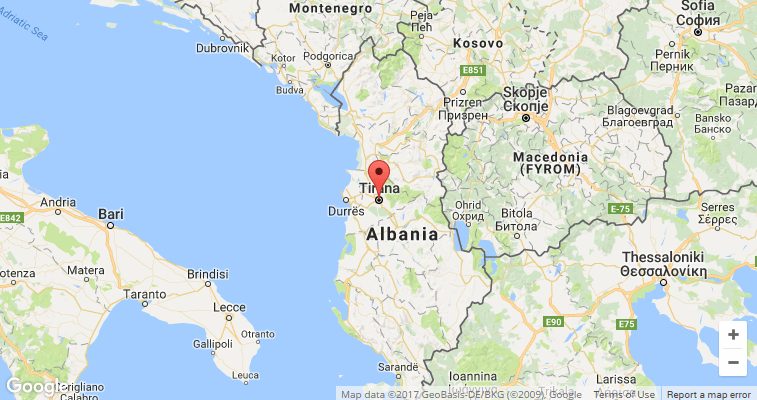
CAPITAL: Tirana
POPULATION OF THE CAPITAL: 374,801
Albania has a total area of 28,748 km2, of which 24 percent is agricultural land, 36 percent forest and 15 percent pasture and meadow. The remaining 25 percent is classified as other, which includes urban areas, lakes, watercourse and (INSTAT, 2015). Population in Albania according to Statistic Office for 2017 was 2876591 inhabitants marking an increase by 0.03 % compare with 2016 (INSTAT, 2017). This increase is attributed to the increase of women population by 0.42 %, while the men population continues to decrease with 0.34 %. The women population comprises 49 % of the total population compared to 51 % of man population. The mean age of the population for 2016 is 37 years old. Mean age for males is 36.4, while for women it is 37.6 years old. The higher mean age of women can be explained by the fact that women have a higher life expectancy (INSTAT, 2016). The number of births for 2016 is approximately 31.7 thousand births. Since 2011, most of the population live in urban areas (53.5 %) and the rest (46.5%) in rural areas.
Albania is considered a rich country in fresh water resources. Inland water surface is 1,350 square kilometers composed by natural lakes (325 square kilometers), coastal lagoons (130 square kilometers), artificial lakes (174 square kilometers) and rivers (721 kilometers). The hydrographic network of Albania includes several of the largest and most ancient bodies of freshwater in Southern Europe. Thus, Shkodra lake is located on the border between Albania and Montenegro, with an area that seasonally can vary between 370 km2 to 600 km2. However, the Ohrid lake is the deepest lake in the Balkan (288 m), the ancient lake in Europe and one of the most ancient in the world. Moreover in Albania you will find also Prespa lakes in the southeast and Butrinti lake in the southwest of the country. Albania is also home to many lagoons, such as: Karavasta, Patoku, Narta, Kunë-Vain and Butrint.
A number of rivers flow into the sea such as: Buna, Drini, Mati, Ishmi, Erzen, Shkumbin, Seman, Vjosa and Bistrica. The contribution of rivers discharging into the Adriatic sea is very large (95 %), compared to the discharge into Ionian sea (5 %). These rivers percolate the whole territory and have various length ranging from 74 kilometres (Buna & Ishmi) to 285 kilometres (Drini).
Mr Yili Hoxha
Director for the Forestry
Ministry of Environment of Albania
1The area and change of the forest area in recent years
According to the Statistical Office[1], forest area in Albania is 1.052 Millions of hectare (covering about 36% of the whole territory), while pastures occupy 478 188 thousands hectares. Generally there is a constant trend in the forest cover change and a decrease of 8% in the pasture area during the last 10 years in Albania. The most significant decrease in pasture area has occurred five years ago (fifty thousand hectares).
Figure 1. Forest and pasture area change during the last ten years (2005-2015)
There is a discrepancy between data reported by Albanian Ministry of Environment and FAO
in forest area and its change over time. Thus, FAO in the Forest Resource Assessment (FRA) of 2015 reported that forests cover 772 000 ha in Albania representing only 28.2% of the whole land area. This discrepancy might be due to the difference in forest definitions between current legal framework in Albania and FAO definitions.
Table 1. Forest area change in Albania during the 1990-2015 period (FRA, 2015)
| Year | Forest area (ha) | Forest area change | |
| ha | % | ||
| 1990 | 789 000 | 0 | 0 |
| 2000 | 769 000 | -20 000 | -2.5 |
| 2010 | 776 000 | 7 000 | 0.9 |
| 2015 | 772 000 | -4 000 | -0.5 |
Forest coverage in Albania has incurred many changes during the last 25 years. Table 2 show an increase in the forest area and a decrease in stocking volume. The period 2010-2015 is the most significant associated with a decrease of volume accounted to -21.2 Million cubic meter.
Table 2. Forest coverage change during the 1990-2015 period
| Year | Forest area (ha) | Stocking volume
(m3) |
Periodic change of the stocking volume
(m3) |
| 1990 | 1046000 | 82697000 | |
| 2000 | 1031600 | 82820000 | 123000 |
| 2005 | 1043600 | 79883000 | -2937000 |
| 2010 | 1043000 | 76504000 | -3379000 |
| 2015 | 1052253 | 55247000 | -21257000 |
1The area of each forest classification and its change. Basis of classification
such as the primary forest, plantation.
The degree of forest naturality indicate the intensity and human intervention history during the forest ecosystems development. The data presented in Table 2, show a significant decrease of the primary forests area which are converted to semi-natural forests.
Table 3. Forest area division according to origin
| Nr | Year | Forest area(ha) | Primary forests | Semi natural forests | Plantation | |||
| ha | % versus total forest area | ha | % versus total forest area | ha | % versus total forest area | |||
| 1 | 1990 | 1046000 | 257000 | 24.6 | 686000 | 65.6 | 103000 | 9.8 |
| 2 | 2000 | 1031000 | 262000 | 25.4 | 673000 | 65.3 | 96000 | 9.3 |
| 3 | 2005 | 1043000 | 261000 | 25.0 | 684000 | 65.6 | 98000 | 9.4 |
| 4 | 2010 | 1043000 | 122000 | 11.7 | 827000 | 79.3 | 94000 | 9.0 |
source: NEA (2013) “Gjëndja e pyjeve në Shqipëri” pg76.
The primary forests are intact by the human influence and they are considered very important because they possess high biodiversity values. They are also important for the study of the influence of climate on forest ecosystems growth and could be use as a reference unit for sustainable development of semi-natural or artificial forests. The decrease of the natural forest area in Albania is mainly caused due to the human interventions such as: logging, wildfire, lack of interventions for natural regeneration etc.
(4) Forestry structure
1The basic situation of the tree species composition such as the area and
percentage for the main tree species;
The diversity of forest species and the dynamism of forest ecosystems is variable all over the country. Most of the forest ecosystems in Albania are composed of 1 or 2 main species for instance: natural forests of beech, oak, black pine etc. Based on the data of NEA (2010) around 64% are pure forest stands, 30% are composed from 2 to 4 species and only 6% of the forest stands comprise more than 6 species in their composition. Forest stands which are part of the protected areas have the highest species composition in Albania. Based on the data of INSTAT (2017), conifer forests cover about 16.6% of the whole forest area and 21% of the overall standing volume. Black pine is the dominant species which occupy around 10% of the whole forest area, followed by Mediterranean pines (5%) and silver fir (1.6%).
Table 4. Forest area coverage and standing volume of conifer species in Albania (Instat,2017)
| Year | Forest area (ha) | Standing volume (1000 m3) | ||||||
| Black pine | Silver fir | Other conifers | Total area(ha) | Black pine | Silver fir | Other conifers | Total volume(m3) | |
| 2012 | 109,000 | 15,180 | 51,180 | 175,360 | 9,028 | 3,203 | 3,874 | 16,105 |
| 2013 | 108,491 | 15,180 | 51,180 | 174,851 | 9,029 | 3,203 | 3,874 | 16,105 |
| 2014 | 108,491 | 15,180 | 51,180 | 174,851 | 9,029 | 3,203 | 3,874 | 16,105 |
| 2015 | 108,468 | 15,180 | 51,157 | 174,806 | 6,543 | 2,321 | 2,808 | 11,672 |
On the other hand broadleaves forests cover about 83.4% of the total forest area and have a stocked volume accounted to 79% of the total standing volume (55 Million cubic meter).
Table 5. Forest area coverage from broadleaves forests in Albania (Instat,2017)
| Year | Forest area (ha) | |||||||
| Beech | Oak | Poplar | Other deciduous | Arbutus | Hornbeam | Other shrubs | Total area(ha) | |
| 2012 | 196,990 | 343,620 | 1,790 | 66,500 | 58,600 | 96,700 | 101,830 | 866,030 |
| 2013 | 196,990 | 343,620 | 1,790 | 66,500 | 58,600 | 96,700 | 101,830 | 866,030 |
| 2014 | 196,990 | 343,620 | 1,790 | 66,500 | 58,600 | 96,700 | 113,721 | 877,921 |
| 2015 | 196,841 | 343,471 | 1,790 | 66,447 | 58,600 | 96,700 | 113,598 | 877,447 |
Table 6. Standing volume per deciduous species in Albania (Instat,2017)
| Year | Standing volume (1000 m3) | |||||||
| Beech | Oak | Poplar | Other decidous | Arbutus | Hornbeam | Other shrubs | Total volume
(1000 m3) |
|
| 2012 | 34,055 | 15,182 | 98 | 3,954 | 2,884 | 2,728 | 1,478 | 60,378 |
| 2013 | 33,815 | 15,182 | 98 | 3,954 | 2,884 | 2,728 | 1,478 | 60,138 |
| 2014 | 33,655 | 15,182 | 98 | 3,954 | 2,884 | 2,728 | 1,478 | 59,978 |
| 2015 | 24,500 | 11,001 | 71 | 2,865 | 2,090 | 1,977 | 1,071 | 43,574 |
The data of the NEA study (2010), indicate that in the composition of Albanian forests take part around 25 species out of which 10 species cover around 97% of the total forest area. This study shows that no significant change exist in the diversity and species composition during the period 1990-2010. The diversity of species composition in Albania is strongly linked with geographic position and their distribution in five phytoclimatic zones.
2The dynamic variation of the tree species in quantity.
The data on the dynamic variation of tree species shows an increase in forest area for conifer species from 2010 to 2012 and a slowdown in the forest area expansion up to 2015.
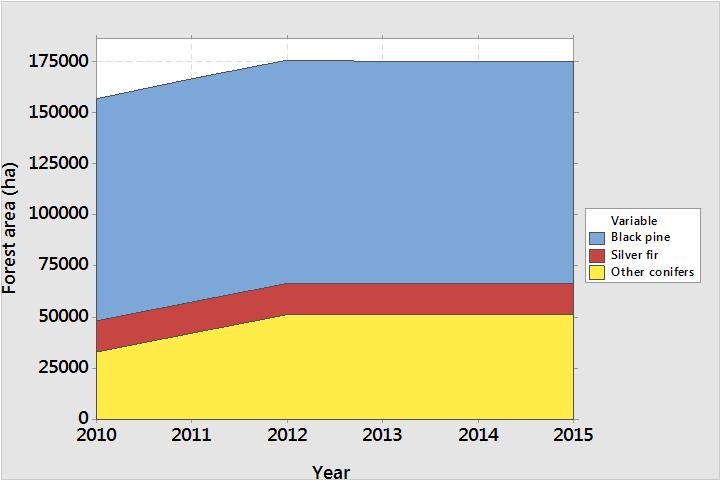
Figure 2. Temporal variability in forest area covered by conifer species
On the other hand data about deciduous tree species indicate that beech forest area is decreased since 2011, while oak forest area showed a steady increase until 2015. The decrease of forest area for beech stands is mainly caused by intensive logging and wildfires. A reduction in the forest area was noted in case of strawberry tree (Arbutus unedo L.) which is an evergreen shrub. In other shrub species was noted an expansion of their coverage in low and hilly lands.
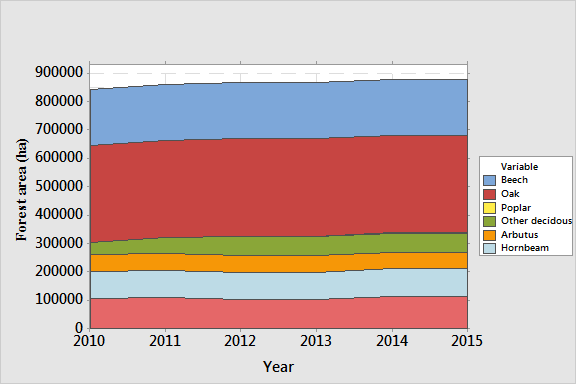
Figure 3. Temporal variability in the forest area for deciduous species
(5) Forest stock volume, increment and logging
1The dynamic variation of the forest stock volume, increment and logging
Albanian Forest Cadastre is the main information system which contains quantitative data about forest area and stocking volume. The current stocking volume according to forest cadastre is 55.2 Million cubic meter (INSTAT, 2017). Over the 1990 – 2000 period, stocking volume has been increased with 123 thousand cubic meter. Thereafter a significant decrease accounted to 32% in stocking volume was noted during the 2006-2015 period. Figure 4 shows a similar trend in the stocking volume of high forests, shrubs and an opposite trend for coppice forests.
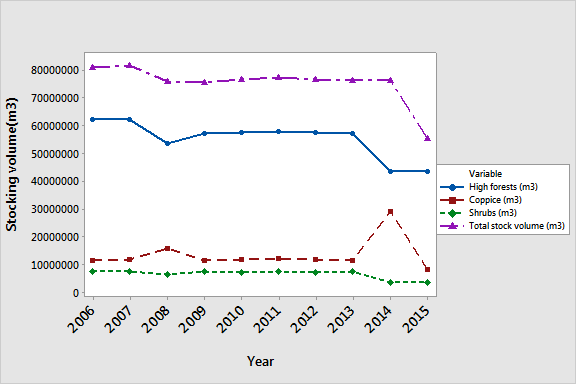
Figure 4. Trend of stocking volume change from 2006 to 2015 (INSTAT,2017)
Figure 4, shows that high forests have been subject of over-logging and damages during the aforementioned period, while the volume of coppice forests is increased because are less harvested and being young forests have a high increment rate. The wrong way performed in the forest resources management during the last 30 years was associated with a negative annual volume increment from 2007 to 2009 as well as from 2012 to 2015 (Figure 5). Based on the data of forest cadastre the annual allowable cut from 1990 to 2005 was estimated 1.52 Million cubic meter, whereas according to National Forest Inventory conducted on 2004 the annual allowable cut for the period 2006 – 2015 was estimated 1.152 Million cubic meter.
Referring the data presented in the Figure 4, the difference in the stocking volume during the period 2006 – 2015 is (-25.8) Million cubic meter, equivalent with 2.58 Million cubic meter per year. This value is 2.23 times higher than the annual allowable cut calculated for the respective period.
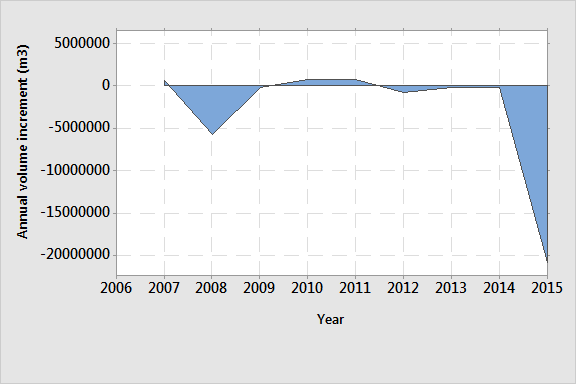
Figure 5. Variability of annual volume increment during the 2006-2015 period in Albania
The stocking volume felled during the 1990-2015 period, shows variability among years having a decreasing trend. The decrease of the harvested volume after 90′ is a complex problem which is related to many reasons. Lack of the state financial funds to invest in opening of new forest roads and limited interventions in many forest parcels in remote areas have affected the forest area and volume obtained by final cutting operations. Meanwhile many private timber processing companies invested a lot of money in manufacturing and this increased the demand for round wood. Firewood, round wood and wood for construction have been the most demanded commodities by the market. Firewood is an important wood fuel and the main source for heating especially in rural areas and in some public institutions such as schools, kindergarten etc.
Table 7. Official logged volume from forest resources in Albania during last 26 years
| Year | Wood materials (m3) | Industrial roundwood
(m3) |
Firewood | Total roundwood
(m3) |
|||||
| Round wood | Wood for Construction | Mining pillars | Branches | Total | mst | m3 | |||
| 1990 | 249,882 | 5,933 | 103,493 | 48,454 | 407,762 | 502,260 | 1,156,288 | 693,634 | 1,195,894 |
| 1991 | 127,374 | 4,405 | 53,256 | 31,361 | 216,396 | 247,440 | 835,752 | 501,351 | 748,791 |
| 1992 | 49,222 | 1,998 | 16,574 | 7,365 | 75,159 | 87,261 | 427,333 | 256,349 | 343,609 |
| 1993 | 57,011 | 5,564 | 6,676 | 1,866 | 71,117 | 84,790 | 600,900 | 536,941 | 621,731 |
| 1994 | 54,729 | 6,420 | 21,348 | 2,041 | 84,538 | 98,875 | 439,024 | 263,362 | 362,249 |
| 1995 | 64,816 | 4,479 | 3,029 | 894 | 73,218 | 89,488 | 324,588 | 194,714 | 292,285 |
| 1996 | 57,591 | 4,840 | 2,373 | 71 | 64,875 | 78,462 | 300,045 | 179,991 | 258,857 |
| 1997 | 19,280 | 2,677 | 2,600 | 581 | 25,138 | 30,303 | 178,188 | 106,891 | 137,335 |
| 1998 | 31,036 | 3,066 | 2,698 | 6,084 | 42,884 | 51,363 | 238,905 | 143,314 | 194,785 |
| 1999 | 53,780 | 5,515 | 2,129 | 71 | 61,495 | 73,212 | 307,107 | 184,227 | 259,451 |
| 2000 | 62,585 | 5,000 | 1,018 | 96 | 68,699 | 82,536 | 279,888 | 167,899 | 253,282 |
| 2001 | 52,332 | 5,576 | 632 | 24 | 58,564 | 70,457 | 242,381 | 145,400 | 220,001 |
| 2002 | 53,464 | 5,068 | 808 | 38 | 59,378 | 71,673 | 302,279 | 181,331 | 262,806 |
| 2003 | 62,086 | 9,355 | 3,466 | 239 | 75,146 | 82,272 | 318,501 | 191,062 | 280,325 |
| 2004 | 49,967 | 6,927 | 1,621 | 130 | 58,645 | 64,243 | 452,724 | 271,580 | 347,169 |
| 2005 | 33,970 | 6,467 | 886 | 322 | 41,645 | 45,584 | 344,238 | 206,501 | 259,924 |
| 2006 | 15,542 | 2,667 | 640 | 59 | 18,908 | 20,699 | 200,193 | 120,092 | 141,765 |
| 2007 | 10,544 | 1,604 | 420 | 48 | 12,616 | 13,815 | 135,472 | 81,267 | 95,430 |
| 2008 | 35,318 | 3,881 | 318 | 34 | 39,551 | 43,365 | 258,417 | 155,019 | 202,340 |
| 2009 | 29,606 | 3,309 | 527 | 32 | 33,474 | 36,695 | 201,840 | 121,080 | 157,922 |
| 2010 | 23,510 | 3,459 | 670 | 34 | 27,673 | 30,313 | 158,971 | 95,364 | 126,609 |
| 2011 | 18,425 | 4,011 | 524 | 32 | 22,992 | 25,159 | 104,197 | 62,506 | 90,208 |
| 2012 | 17,867 | 3,615 | 868 | 47 | 22,397 | 24,506 | 1,356,467 | 813,717 | 838,223 |
| 2013 | 24,436 | 5,167 | 613 | 0 | 30,216 | 33,069 | 1,380,369 | 828,056 | 866,268 |
| 2014 | 31,497 | 5,449 | 700 | 0 | 37,646 | 40,156 | 1,315,746 | 787872 | 825,518 |
| 2015 | 10,754 | 1,727 | 241 | 0 | 12,722 | 14,345 | 1,264,232 | 757025 | 769,747 |
The difference between the forest cadastre data in the mean annual volume logged ( 2.58 Million cubic meter) and the data presented in the Table 5 for the last 10 years (2006-2015) is caused due to illegal logging and forest fires (especially during 2007).
(6) Felling operation
During the 1990-1993 period the felling operations in forest areas have been conducted by state harvesting enterprises which were qualified and possessing the adequate tools and equipments. From September 1993 up to now, felling operations in forest areas are performed by private logging companies which buy the standing timber in auctions. Private logging companies are responsible to respects the technical standards during the logging processes and timber transportation outside the forest parcels
1The total volume of timber felled in recent 10 years
The total volume felled during the last 10 years range from 90,208 cubic meter (2011) to 866,268 cubic meter (2013). Industrial wood represent only 2% of the total logged volume while the firewood is the dominant wood commodity because is an important source of heating used across Albania, especially in the rural areas. The results of FAO study (FAO 2016) on wood fuel consumption in Albania show that average consumption in households using firewood was 5.36 m3, with 5% higher consumption in rural households and 8,9 % lower consumption in urban areas. Wisdom analysis used in this study show that total wood fuel consumption coming directly from forests in Albania is estimated to be 2,479,093 m3.
Table 8. Quantity of the timber felled during the last 10 years in Albania
| Year | Wood materials (m3) | Industrial roundwood
(m3) |
Firewood | Total roundwood
(m3) |
|||||
| Round wood | Wood for Construction | Mining pillars | Branches | Total | mst | m3 | |||
| 2006 | 15,542 | 2,667 | 640 | 59 | 18,908 | 20,699 | 200,193 | 120,092 | 141,765 |
| 2007 | 10,544 | 1,604 | 420 | 48 | 12,616 | 13,815 | 135,472 | 81,267 | 95,430 |
| 2008 | 35,318 | 3,881 | 318 | 34 | 39,551 | 43,365 | 258,417 | 155,019 | 202,340 |
| 2009 | 29,606 | 3,309 | 527 | 32 | 33,474 | 36,695 | 201,840 | 121,080 | 157,922 |
| 2010 | 23,510 | 3,459 | 670 | 34 | 27,673 | 30,313 | 158,971 | 95,364 | 126,609 |
| 2011 | 18,425 | 4,011 | 524 | 32 | 22,992 | 25,159 | 104,197 | 62,506 | 90,208 |
| 2012 | 17,867 | 3,615 | 868 | 47 | 22,397 | 24,506 | 1,356,467 | 813,717 | 838,223 |
| 2013 | 24,436 | 5,167 | 613 | 0 | 30,216 | 33,069 | 1,380,369 | 828,056 | 866,268 |
| 2014 | 31,497 | 5,449 | 700 | 0 | 37,646 | 40,156 | 1,315,746 | 787872 | 825,518 |
| 2015 | 10,754 | 1,727 | 241 | 0 | 12,722 | 14,345 | 1,264,232 | 757025 | 769,747 |
2The planned felling volume in the next 10 years.
The information on planned felling volume for the next 10 years is not available because the field work for the next National Forest Inventory in Albania will start on 2018. Only after the completion of this activity will be possible to estimate the felling volume for the next 10 years.
[1] http://www.instat.gov.al/al/themes/mjedisi.aspx
Brief description of the Forest-related policies and laws
European integration is the main priority of Albanian foreign policy since the beginning of 90’s. To achieve this purpose the Albanian legislation on forest and environment must be improved and regulated according to European Union. In this regard, the drafting of policies and legislation on forests constitutes one of the main areas that have undergone a deep reform, which will continue even further towards reaching the European standards on forest protection and their sustainable development. In order that forestry policies to be implementable they need to rely on a complete legal framework. The earliest regulation dealing with the use of forests in Albania was the Code of Lekë Dukagjini, which was compiled on the 15th century. The first legal act related to forestry in Albania was the “Law on forests and pastures” of 27 January 1923. It defined three categories of ownership over forests (state, communal, and private). During the communist regime in Albania after the end of the Second World War the private forests and pastures were completely eradicated and all forests and pastures were state owned. With the collapse of the communist system in Albania, the parliament enacted a new law on forests in 1992, which was focused on: (i) the process of forest administration restructuring, (ii) privatization of forest harvesting companies, (iii) restitution of forests and pastures to former owners. A new law Nr 9385 “For forests and forest service” was enacted on 2005. This law on forests has been amended several times, in order to adapt to changes and reflect the new realities. Moreover on 2004, the Council of Ministers approved the Strategy for the Development of Forests and Pastures which had these main objectives: the protection of the entire forest fund, its sustainable management, the application of market economy principles in all aspects of the forestry sector, the transfer of forests for communal use, the development of tourism. The fundamental aspects of the policy and legal reform on forests and pastures during the last 27 years have been:(i) orientation of forest sector towards the market economy, (ii) the restitution of forests to the former owners, (iii) decentralization of the administration of forest areas from government to municipalities.
Investigation and monitoring of forestry resources
NEA is responsible for the investigation and monitoring of forestry resources in Albania. This government body makes monitoring based on the Pan-European criterions (6) and indicators (35), which are developed as a common instrument for the monitoring policy, assessment and reporting of the sustainable management of forest resources. The information is provided from various sources including Forest Cadastre, INSTAT, monitoring network of forest status and reports or studies carried out by international organization like FAO,UNECE,UNEP, WWF, WB etc.
Forest economics
Forest contribution to GDP
Forests have played an important role in the development of the economy and society in Albania. At present, they cover an area of 1,052,253 hectares, equal to 36% of the total area of the country (INSTAT, 2017). Apart from the economic aspects, forests provide environmental, social and cultural benefits. The Gross Domestic Product (GDP) in Albania was 11.93 billion US dollars in 2016 (https://tradingeconomics.com/albania/gdp) and the projected GDP growth for 2017 is 3.46%. Because forestry has traditionally been considered as closely related to agriculture, there is no separate data regarding its contribution to the country’s economy. Statistics show that agriculture sector contribution in the GDP has been reduced over the years, from 42.5% in 1992, to 21.6% in 2016 (https://en.wikipedia.org/wiki/Economy of Albania) but no specific data is available regarding to forest sector contribution in GDP.
1Gross added value of forestry, the country’s GDP and the share of forestry’s contribution;
Total gross value-added in the (formal) forestry sector has not changed much during the period 2000 to 2011, with an average value of 66.2 Million USD per year (in real terms) and annual figures within ± five percent of this average. Among the two sub-sectors, the forestry sub sector makes the largest contribution to GDP, accounting for almost 0.55%. If we include also the gross value added for non wood products estimated in 20 Million USD per year than the contribution of forest sector goes to 0.8% per year. Value-added per unit of output has decreased in the forestry and wood industry sub-sector during 2000 to 2011 because of the forests over exploitation.
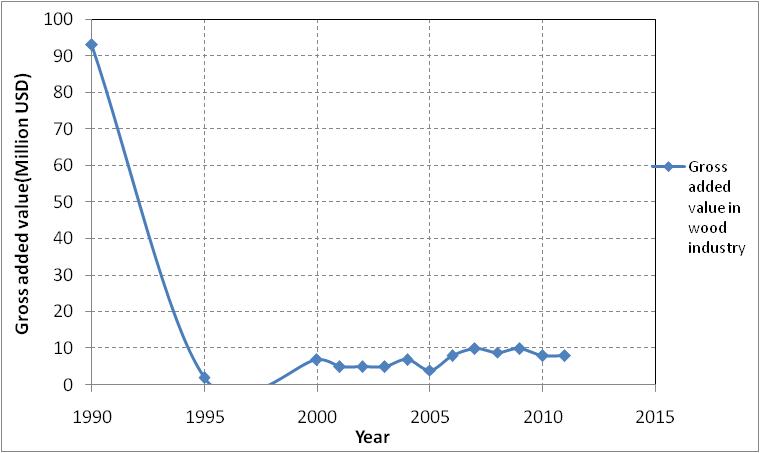
Figure 8.Gross added value of forestry(upper) and wood industry (below) sectors (FAO. 2014. Contribution of the forestry sector to national economies, 1990-2011, by A. Lebedys and Y. Li. Forest Finance Working Paper FSFM/ACC/09. FAO, Rome)
Forestry – related industrial chain
One of the most important aspects of forest commodity chain is the balance between wood industry demand and wood production from forests resources managed in sustainable way. The security of wood supply depends on adequate forest production capacity and forest management. In turn, the sustainability of upstream timber production and security of many other environmental goods and services depends on good forest governance, which ensures a balance of all forest goods and services. The current potential of forests resources is too low due to the dominance of young forests (covering 55% of total forest area) and low productivity (59.1 m3/ha) of forests (ANFI, 2004). For that reason the wood industry sector to ensure the adequate timber quantity is strongly depending on the wood import. The statistics of wood products import indicate that each year our wood-based industry import on average 221260 cubic meter with a cost of 220 Million USD.
1 Yield and output value of wood and non-wood forest products
Based on the data of the last National forest Inventory (2004) the annual timber production is estimated about 1.15 Million cubic meter. The official data showed that the average quantity of industrial wood felled annually is 28,212 cubic meter while the quantity of firewood felled is around 382,200 cubic meter. Various study has shown that wood fuel consumption is much higher than the official figure and the most recent study of FAO (2017) indicated that total wood fuel consumption coming directly from forests in Albania is estimated to be 2,479,093 m3. Beside wood, another product coming directly from forests are the aromatic and medicinal plants (MAPs). They are an important source of revenues especially for the household economy in rural area generating more than 19 Million $ USD each year. Estimates of people involved in the aromatic and medicinal plants collection range between 75,000 and 100,000 making MAPs the most important forestry sub-sector in terms of involvement local communities. Almost all families in rural areas get a significant share of their income from MAPs collection ranging from 15% to 20%. The value chain is mainly export-oriented where about 60% of MAPs are shipped to Germany and USA. Albania is a major international player for some MAPs products, such as sage, thyme, oregano and winter savory. The statistics of the MAPs export during the last 10 years show that the marketing of these products suffered a dramatic drop in 2009 due to the Global Economic Crisis. Immediately after 2009, the export of MAPs was followed by a steady increase. While MAPs export increased at 23% per annum in terms of value reaching over 20 million USD, it increased at 18% per annum in terms of volume corresponding a quantity of 9100 tons.
Forest products import and export trade
Import volume, import value, export volume, export value for all wood and non-wood forest products since 2010 (or 2000).
The examination of the level of export and imports of wood products for the period 2006-2016 showed that Albania has exported about 81278992 Million USD of wood fuel, charcoal, industrial wood, sawn wood, wood chips and MDF, while imported about 220619031 Million USD for the same period of time making the import-export ratio for this category to be approximately 2.7 to 1. The import of wood, and other wood commodities has been steadily increasing since 2012 going from 138.2 Million USD in 2006 to 320.6 Million USD in 2016. This year marks the largest increase compare with previous periods. Meanwhile, exports shows many fluctuations and the discrepancy between export and import is increasing after 2012, showing a diverse trend compare to each other. In 2011 the export of wood products showed the largest decline reaching a value of 41760 cubic meter in wood quantity.
Figure 9. Temporal variability of wood export and import during the last 10 years
Table 11. Export volume and their respective value for all wood products
| Year | Exported wood quantity | Other wood products exported | Economic value $ USD | |||||||||
| Wood fuel
(m3) |
Charcoal4
(m3) |
Round wood
(m3) |
Sawn wood
(m3) |
Wood chips and residues
(m3) |
MDF/HDF | Mechanic wood pulp
(m3) |
Other fiberboard
(m3) |
Particle board and OSB
(m3) |
Plywood
(m3) |
Veneer sheets
(m3) |
||
| 20061 | 56300 | 13160 | 467 | 21409 | 39003 | 13 | 0 | 0 | 0 | 0 | 6601000 | |
| 20071 | 56300 | 13160 | 467 | 21409 | 39003 | 13 | 0 | 0 | 0 | 0 | 6601000 | |
| 20081 | 56300 | 13160 | 467 | 21409 | 39003 | 13 | 0 | 0 | 0 | 0 | 6601000 | |
| 20091 | 56300 | 9212 | 467 | 21409 | 39003 | 13 | 0 | 0 | 0 | 0 | 6270000 | |
| 20101 | 56300 | 8883 | 467 | 21409 | 39003 | 13 | 0 | 0 | 0 | 0 | 6305000 | |
| 20111 | 7452 | 6580 | 8466 | 5862 | 134003 | 03 | 0 | 0 | 0 | 0 | 7630000 | |
| 20122 | 75,900 | 10,805 | 2,641 | 6546 | 390003 | 12003 | 103 | 0 | 0 | 0 | 0 | 8124000 |
| 20132 | 80,801 | 13,270 | 3,000 | 6550 | 390003 | 12003 | 103 | 0 | 0 | 0 | 0 | 8124000 |
| 20142 | 68,523 | 4,957 | 3,000 | 6550 | 390003 | 12003 | 103 | 0 | 0 | 0 | 0 | 8124000 |
| 20152 | 88,142 | 3,290 | 3,000 | 850 | 390003 | 12003 | 103 | 0 | 0 | 0 | 0 | 8737806 |
| 20162 | 75900 | 3,291 | 3,000 | 850 | 390003 | 12003 | 103 | 0 | 0 | 0 | 0 | 8161186 |
Table 12. Import volume and its economic value for all wood products
| Year | Imported wood quantity | Other wood products imported | Economic value
( $ USD) |
|||||||||
| Wood fuel
(m3) |
Charcoal
(m3) |
Round wood
(m3) |
Sawn wood
(m3) |
Wood chips and residues
(m3) |
MDF/HDF
(m3) |
Mechanic wood pulp(m3) | Other fiber board
(m3) |
Particle board and OSB
(m3) |
Plywood
(m3) |
Veneer sheets
(m3) |
||
| 20061 | 652 | 23890 | 5600 | 0 | 2400 | 91600 | 748 | 291 | 138225000 | |||
| 20071 | 652 | 23890 | 5600 | 0 | 2400 | 91600 | 748 | 291 | 138225000 | |||
| 20081 | 652 | 23890 | 5600 | 0 | 2400 | 60000 | 748 | 291 | 117489000 | |||
| 20091 | 652 | 23890 | 5600 | 0 | 2400 | 77000 | 748 | 291 | 135134000 | |||
| 20101 | 1860 | 23890 | 5600 | 0 | 2400 | 78000 | 748 | 291 | 136565000 | |||
| 20111 | 6 | 65.8 | 7336 | 110365 | 40000 | 7 | 64000 | 78000 | 2770 | 1285 | 343085000 | |
| 20122 | 817 | 89 | 4,642 | 43,870 | 64 | 42000 | 20 | 52000 | 79000 | 1,476 | 1,252 | 217726984 |
| 20132 | 5,513 | 65 | 4,572 | 43,598 | 42000 | 20 | 52000 | 79000 | 1,378 | 881 | 217845816 | |
| 20142 | 8,706 | 71 | 25,352 | 45,281 | 42000 | 20 | 52000 | 79000 | 1,825 | 1,190 | 220423715 | |
| 20152 | 3,705 | 749 | 41,130 | 41,948 | 42000 | 20 | 52000 | 79000 | 2,133 | 656 | 220834796 | |
| 20162 | 100000 | 0 | 20,000 | 73100 | 42000 | 20 | 52000 | 79000 | 1000 | 1290 | 320636000 | |
source: 1 REC (2015); 2 INSTAT (2017); 3FAOSTAT(http://www.fao.org/faostat/en/#data/FO) ; 4 1 tons =3.29 m3 of wood charcoal
[1] http://www.instat.gov.al/al/themes/mjedisi.aspx
Forest Management
1Governmental organizations
During the 1990-2005 period the forest and pasture sector has been under the responsibility of the Ministry of Agriculture and the administration of the forest resources was conducted by the General Directorate of Forests and Pastures. The forest resource administration at local level was done from the Forest Service Directorates which were operating in 36 districts. From January 2006 up to 2013 the forest and pasture sector has been under the responsibility of the Ministry of Environment (nowadays called Ministry of Tourism and Environment). Administration of the forest fund was done at central level by (i) Directorate of Forest and Pasture Policies; (ii) Directorate for Nature Conservation and (iii) Forest Police as part of the State Inspectorate for Environment, Forests and Water Resources. After the reorganization on 2013 the administration of forest resources was done by only two units: (i) Directorate for Forest Treatment and Protection and (ii) Forest Police as part of the State Inspectorate for Environment, Forests and Water Resources. The territorial reform and new administrative organization in 61 municipalities was associated with decentralization of the forest administration from government to the new municipalities. Recently each municipality is responsible for management of the forest resources inside their territory and almost all have employed forest specialists for administration and protection of forest and pasture areas.
Another government organization in the forestry sector is the National Environment Agency (NEA). This unit is responsible for monitoring, protection and improvement of environment. It is involved in the scientific research which is responsibility of the Directorate for Technology Transfer. It is also responsible for implementation of the National Forest Inventory and monitoring of forest cover and its temporal change.
National Agency for Protected Areas (NAPA) is responsible for the management of the protected area and other natural networks as Natura2000 under management plans. NAPA monitors and inventory the flora and fauna in these areas, as well as promote tourism, recreational, cultural, gastronomic, esthetic, health and spiritual values of protected areas. Management and administration of protected areas are be the main pillars of the NAPA work.
2Non-governmental organizations
The forest and pasture user associations are organised at local level and their task is coordination between forest users at village level. They area engaged in the implementation of acitivities which are related to forest management at administrative unit level. These associations are organised at regional level and constitute the Regional Federation of Forests and Pastures which is also part of the National Federation for Forests and Pastures. These are non-profit organisations and represent the interest of all users of forests and pastures in Albania.
CNVP is another important partner for development of forest resources in Albania. It works with public, private, donor using evidence-based analysis to improve the sustainable livelihoods of rural communities. The focus of CNVP work includes six main areas: sustainable forest management, climate change, environment and natural resource management, agro- rural development, renewable energy and waste management. In Albania there area many other non-governmental organizations which pursue their activity in wildlife and environment protection.
Forestry Research and Education
1Forest related institutions
Faculty of Forestry Sciences is the only institution of high education which according to the Law of Higher Education is responsible for the scientific research in the forestry field. The mission of this entity is education, scientific research and the expertise in forestry. NEA is also engaged in scientific research acitivity by means of the Directorate for Technology transfer focused in the monitoring of the forest state and their vitality, biodiversity, soil erosion etc.
Faculty of Forestry Sciences is part of the Agriculture University of Tirana. It is the only institution for high education in the forestry field. The technical school for forestry is situated in Shkodra town. It is another education institution which offer various programs for preparation and education of forest technicians in silviculture, reforestation, forest logging etc.
1List of forestry universities
Faculty of Forestry Sciences is part of the Agriculture University of Tirana. It is the only institution for high education in forestry field in Albania.
2The forestry related majors in each forestry universities
The rector of the Agriculture University of Tirana is Prof. Dr. Bahri MUSABELLIU, while the Dean of the Faculty of Forestry Sciences is Prof. assoc. Leonidha PERI.
Number of forest-related students and the international students
Faculty of Forestry Sciences is established since 1959 and is the only higher education institution in Albania. More than 1800 students are graduated in this institution and all students have worked for decades as forest engineer or silviculture specialists in public or private forest sector. Faculty of Forestry Sciences offers training courses and summer schools not only for Albanian students but also for international students and is actively involved in various national or international projects.
Get the latest news and information about China and CEEC Cooperation – Forestry Mechanism.